Martial Arts Why Dont People Show Up for Trial
Indian martial arts refers to the fighting systems of the Indian subcontinent. A diverseness of terms are used for the English phrases "Indian martial arts", usually deriving from Dravidian sources. While they may seem to imply specific disciplines (e.thousand. archery, armed combat), by Classical times they were used generically for all fighting systems.
Among the most mutual terms today, śastra-vidyā, is a compound of the words śastra (weapon) and vidyā (knowledge).[i] Dhanurveda derives from the words for bow ( dhanushya ) and noesis ( veda ), the "science of archery" in Puranic literature, later applied to martial arts in general.[2] [ self-published source? ] The Vishnu Purana text describes dhanuveda every bit one of the traditional xviii branches of "applied noesis" or upaveda, along with shastrashastra or military science.[3] A later term, yuddha kalā, comes from the words yuddha meaning fight or combat and kalā meaning art or skill. The related term śastra kalā (lit. weapon fine art) usually refers specifically to armed disciplines. Another term, yuddha-vidyā or "combat knowledge", refers to the skills used on the battleground, encompassing non only actual fighting but likewise boxing formations and strategy. Martial arts are commonly learnt and adept in the traditional akharas.[4] [v]
History [edit]
Antiquity (pre-Gupta) [edit]
An Indus valley civilization seal shows 2 men spearing i another in a duel which seem to be centered on a woman. A statue of a spear thrower was also excavated from an Indus valley site.[6]
Dhanurveda, a department found in the Vedas (1500 BCE - 1100 BCE) contains references to martial arts.[7] [8] Indian epics contain the earliest accounts of gainsay, both armed and bare-handed. Most deities of the Hindu-Buddhist pantheon are armed with their own personal weapon, and are revered not only as master martial artists only frequently as originators of those systems themselves.[ix] The Mahabharata tells of fighters armed only with daggers besting lions, and describes a prolonged battle between Arjuna and Karna using bows, swords, trees, rocks and fists.[three] Some other unarmed battle in the Mahabharata describes two combatants boxing with clenched fists and fighting with kicks, finger strikes, articulatio genus strikes and headbutts.[10]
The oldest recorded organized unarmed fighting fine art in the Indian subcontinent is malla-yuddha or gainsay-wrestling, codified into four forms in the Vedic Period. Stories describing Krishna report that he sometimes engaged in wrestling matches where he used articulatio genus strikes to the chest, punches to the head, hair pulling, and strangleholds.[11] Based on such accounts, Svinth (2002) traces press-ups and squats used by Indian wrestlers to the pre-classical era.[11]
In Sanskrit literature the term dwandwayuddha referred to a duel, such that it was a battle between only two warriors and not armies. Epics oftentimes describe the duels between deities and god-like heroes as lasting a month or more. The malla-yuddha (wrestling match) betwixt Bhima and Jarasandha lasts 27 days. Similarly, the dwandayuddha between Parasurama and Bhishma lasts for 30 days, while that between Krishna and Jambavan lasts for 28 days. Also, the dwandwayudda between Bali and Dundubhi, a demon in the course of a water buffalo, lasts for 45 days. The Manusmriti tells that if a warrior's topknot comes loose during such a fight or duel, the opponent must give him fourth dimension to demark his hair before standing.
The Charanavyuha authored by Shaunaka mentions four upaveda (applied Vedas). Included amongst them are archery (dhanurveda) and military sciences (shastrashastra),[7] [8] the mastery of which was the duty (dharma) of the warrior class. Kings normally belonged to the kshatria (warrior) form and thus served as heads of the army. They typically skillful archery, wrestling, boxing, and swordsmanship as part of their education.[12] Examples include such rulers as Siddhartha Gautama and Rudradaman. The Chinese monk Xuanzang writes that the emperor Harsha was light on his feet despite his advancing historic period and managed to dodge and seize an assailant during an assassination endeavor.[13]
Many of the pop sports mentioned in the Vedas and the epics have their origins in military machine training, such as battle (musti-yuddha), wrestling (maladwandwa), chariot-racing (rathachalan), horse-riding (aswa-rohana) and archery (dhanurvidya).[fourteen] Competitions were held non just equally a contest of the players' prowess but also as a means of finding a bridegroom. Arjuna, Rama and Siddhartha Gautama all won their consorts in such tournaments.
In the third century, elements from the Yoga Sutras of Patanjali, also equally finger movements in the nata dances, were incorporated into the fighting arts.[xi] A number of Indian fighting styles remain closely continued to yoga, dance and performing arts. Some of the choreographed sparring in kalaripayat tin be applied to dance[15] and kathakali dancers who knew kalaripayat were believed to be markedly better than other performers. Until contempo decades, the chhau dance was performed simply by martial artists. Some traditional Indian classical dance schools all the same incorporate martial arts as part of their practice regimen.[sixteen]
Written evidence of martial arts in Southern India dates back to the Sangam literature of about the 2nd century BC to the 2nd century AD. The Akananuru and Purananuru draw the apply of spears, swords, shields, bows and silambam in the Sangam era. The word kalari appears in the Puram (verses 225, 237, 245, 356) and Akam (verses 34, 231, 293) to describe both a battlefield and combat arena. The word kalari tatt denoted a martial feat, while kalari kozhai meant a coward in war.[17] Each warrior in the Sangam era received regular military machine training[18] in target practise and horse riding. They specialized in one or more of the important weapons of the menstruation including the spear (vel), sword (val), shield (kedaham), and bow and arrow (vil ambu). The combat techniques of the Sangam period were the earliest precursors to kalaripayat.[3] References to "Silappadikkaram" in Sangam literature appointment back to the 2nd century. This referred to the silambam staff which was in slap-up demand with foreign visitors.[19] [xx]
The x fighting styles of northern sastra-vidya were said to have been created in different areas based on animals and gods, and designed for the particular geography of their origin.[ citation needed ] Tradition ascribes their convergence to the 6th-century Buddhist university of Takshashila,[ citation needed ] ancient India's intellectual uppercase. Located in present-day Panjab, Pakistan, the Ramayana ascribes the metropolis's founding to Bharata who named it afterwards his son Taksha. From the 7th to the 5th centuries BC information technology was held in loftier regard equally a great centre of trade and learning,[21] attracting students from throughout present-day Pakistan and northern India. Amidst the subjects taught were the "war machine sciences", and archery was one of its prime number arts.
Some measures were put into place to discourage martial activity during the Buddhist catamenia. The Khandhaka in particular forbids wrestling, boxing, archery, and swordsmanship. However, references to fighting arts are found in early on Buddhist texts, such as the Lotus Sutra (c. 1st century AD) which refers to a boxing art while speaking to Manjusri.[22] It besides categorised combat techniques as articulation locks, fist strikes, grapples and throws. The Lotus Sutra makes farther mention of a martial art with dance-like movements called Nara. Some other Buddhist sutra called Hongyo-kyo (佛本行集經) describes a "forcefulness contest" betwixt Gautama Buddha's half-blood brother Prince Nanda and his cousin Devadatta.[22] Siddhartha Gautama himself was a champion wrestler and swordsman before condign the Buddha.[eleven]
Classical period (tertiary to 10th centuries) [edit]
Like other branches of Sanskrit literature, treatises on martial arts become more than systematic in the course of the 1st millennium AD. Vajra-musti, an armed grappling style, is mentioned in sources of the early on centuries AD.[22] Around this time, tantric philosophers developed important metaphysical concepts such as kundalini, chakra, and mantra.[11]
The Sushruta Samhita (c. 4th century) identifies 108 vital points on the human being torso[23] of which 64 were classified every bit existence lethal if properly struck with a fist or stick.[11] Sushruta'due south piece of work formed the basis of the medical subject field ayurveda which was taught alongside diverse martial arts.[xi] With numerous other scattered references to vital points in Vedic and epic sources, it is certain that Indian subcontinent's early fighters knew and practised attacking or defending vital points.[24]
Effectually 630, Male monarch Narasimhavarman of the Pallava dynasty commissioned dozens of granite sculptures showing unarmed fighters disarming armed opponents. This is similar to the style described in the Agni Purana.[11]
Martial arts were not exclusive to the kshatriya caste, though the warrior grade used them more than extensively. The 8th-century text Kuvalaymala by Udyotanasuri recorded fighting techniques being taught at educational institutions, where non-kshatriya students from throughout the subcontinent "were learning and practicing archery, fighting with sword and shield, with daggers, sticks, lances, and with fists, and in duels (niyuddham)".[3] Hindu priests of the traditional gurukula still teach unarmed fighting techniques to their students as a way of increasing stamina and training the physical body[ citation needed ].
The Gurjara-Pratihara came into power during the 7th century and founded a kyshatria dynasty in northern India which exceeded the preceding Gupta Empire. During this period, Emperor Nagabhata I (750–780 AD) and Mihir Bhoja I (836–890) commissioned various texts on martial arts, and were themselves practitioners of these systems. Shiva Dhanuveda was equanimous in this era. The khadga, a two-handed broad-tipped heavy longsword, was given special preference. It was even used for khadga-puja, ritualised worship of the sword. The Gurjara-Pratiharas continuously fought off Arab invasions, especially during the Caliphate campaigns in India. The Arab chronicler Sulaiman wrote of the Gurjara ruler every bit the greatest foe to Islamic expansion, while at the same fourth dimension praising his cavalry.[25] The Gurjara people all the same keep upwardly their tradition of gatka and kushti, and until today there are world-class wrestlers from the customs competing at national and international levels.
Middle Ages (11th to 15th centuries) [edit]
Kalaripayat had developed into its present grade past the 11th century, during an extended catamenia of warfare betwixt the Chera and Chola dynasties.[11] [fifteen] The earliest treatise discussing the techniques of malla-yuddha is the Malla Purana (c. 13th century), unlike the earlier Manasollasa which gives the names of movements but no descriptions.[26]
Over a period of several centuries, invading Muslim armies managed to occupy much of nowadays-mean solar day Pakistan and northern India. In response to the spread of Muslim rule,[27] the kingdoms of South Republic of india united in the 14th century to found the Vijayanagara Empire. Concrete civilization was given much attention past both royalty and commoners in the empire, with wrestling being particularly popular with both men and women.[28] Gymnasiums accept been discovered inside purple quarters of Vijayanagara, and records speak of regular physical training for commanders and their armies during peacetime.[29] Regal palaces and market places had special arenas where royalty and common people alike amused themselves past watching matches such as cockfights, ram fights, and wrestling. One account describes an akhara in Chandragiri where noblemen practiced jumping exercises, boxing, fencing and wrestling almost every solar day before dinner to maintain their wellness, and observed that "men as quondam as seventy years look just 30".[30]
The Italian traveller Pietro Della Valle wrote of pikestaff-fighting in southern India. According to Pietro, it was the custom for soldiers to specialise in their own particular weapon of expertise and never use any other even during war, "thereby becoming very expert and well practised in that which he takes to".[31]
As their aboriginal predecessors, swordplay and wrestling were normally practiced past the royalty of Vijayanagara. Krishna Deva Raya is said to have arranged a duel between a champion swordsman and the prince of Odisha who was known for beingness an practiced with both the sword and dagger. The prince accepted the challenge until he learned he would be fighting one not of royal claret and so killed himself rather than having to "soil his hands". Fernao Nunes and the Western farsi envoy Adbur Razzak relate that Deva Raya 2 survived an assassination effort "as he was a man who knew how to use both sword and dagger better than anyone in his kingdom, avoided past twists and turns of his trunk the thrusts aimed at him, freed himself from him, and slew him with a short sword that he had."[32]
Mughal era (1526–1857) [edit]
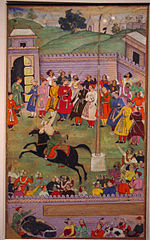
Mughal warriors practicing horseback archery, a skill they were highly renowned for
After a serial of victories, the Fundamental Asian conqueror Babur established Mughal rule in n Republic of india during the 16th century. The Mughals were patrons of India's native arts, not simply recruiting akhara-trained Rajput fighters for their armies but even practicing these systems themselves.[33] The Ausanasa Dhanurveda Sankalanam dates to the late 16th century, compiled under the patronage of Akbar.[34] The Ain-i-Akbari tells that the Mughal court had various kinds of fighting men from around the empire who would demonstrate their skills every day in substitution for rewards. Amongst them were said to be both native and Mughal wrestlers, slingers from Gujarat, Hindustani athletes, boxers, rock-throwers and many others.
"At that place are several kinds of gladiators, each performing astonishing feats. In fighting they show much speed and agility and blend courage and skill in squatting down and rising up again. Some of them employ shields in fighting, others use cudgels. Others once again use no means of defence force, and fight with 1 hand only; these are called ek-hath. Those who come up from the eastern districts of Hindostan use a small shield called "chirwah". Those from the southern provinces have shields of such magnitude equally to cover a man and a horse. This kind of shield is called tilwah. Some other grade apply a shield somewhat less than the height of a man. Some again use a long sword, and seizing information technology with both hands they perform extraordinary feats of skill. There is some other famous course chosen Bankúlis. They have no shield but make use of a peculiar kind of sword which, though curved towards the indicate, is straight near the handle. They wield it with swell dexterity. The skill that they exhibit passes all clarification. Others are adept in fighting with daggers and knives of diverse forms; of these at that place are upwards of a hundred thousand. Each class has a dissimilar name; they also differ in their performances. At courtroom, there are a 1000 gladiators always in readiness."[35]
Gorging hunters, a popular sport amid the Mughals was shikar or tiger-hunting. While frequently done with arrows and subsequently even rifles, information technology was considered nigh impressive to kill a tiger with a manus-to-hand weapon such as a sword or dagger.[36] A warrior who managed to best a tiger would be awarded the title of Pachmar.
In the 16th century, Madhusudana Saraswati of Bengal organised a department of the Naga tradition of armed sannyasi in club to protect Hindus from the intolerant Mughal rulers. Although generally said to abide by the principle of non-violence (ahimsā), these Dashanami monks had long been forming akhara for the practice of both yoga and martial arts. Such warrior-ascetics have been recorded from 1500 to equally late as the 18th century,[37] although tradition attributes their cosmos to the 8th-century philosopher Sankaracharya. They began as a stratum of Rajput warriors who would get together after harvest and arm peasants into militarised units, effectively acting as a self-defense squad. Prevalent in Rajasthan, Maharashtra and Bengal, they would give up their occupations and leave their families to live as mercenaries. Naga sadhu today rarely exercise whatsoever course of fighting other than wrestling, but nevertheless carry trishula, swords, canes and spears. To this day their retreats are called chhauni or armed camps, and they have been known to hold mock jousts among themselves. As recently as the 1950s, it was not unusual for Naga sadhu to strike to kill someone over problems of honour.[spider web 1]
There is also a 17th-century Dhanurveda-samhita attributed to Vasistha.
The pehlwani mode of wrestling developed in the Mughal Empire by combining native malla-yuddha with influences from Farsi varzesh-e bastani.[38] [39]
Maratha dynasty (1674–1859) [edit]

Statue of Shivaji, the warrior-king who brought the Maratha people and fighting style to prominence.
Coming from a hilly region characterized by valleys and caves, the Marathas became proficient horsemen who favoured light armour and highly mobile cavalry units during war. Known particularly as masters of swords and spears, their heavily martial culture and propensity for the lance is mentioned as early as the 7th century by Xuanzang.[xiii] After serving the Dakshin sultanates of the early 17th century, the scattered Marathas united to found their own kingdom nether the warrior Shivaji. Having learned the native art of mardani khela from a young age, Shivaji was a chief swordsman and expert in the employ of various weapons.[40] He took advantage of his people's expertise in guerilla tactics (Shiva sutra) to re-establish Hindavi Swarajya (native [Hindu being a term traditionally practical to the native inhabitants of Republic of india throughout antiquity] cocky-rule) at a fourth dimension of Muslim supremacy and increasing intolerance.[21] Utilizing speed, focused surprise attacks (typically at nighttime and in rocky terrain), and the geography of Maharashtra, Karnataka, & South Bharat; the Maratha rulers were successfully able to defend their territory from the more numerous and heavily armed Mughals.[41] The still-existing Maratha Lite Infantry is one of the "oldest and near renowned" regiments of the Indian Ground forces, tracing its origins to 1768.[42]
Paika Rebellion [edit]
Paika is the Odia discussion for fighter or warrior. Their training schools, known every bit paika akhada, can be traced back to aboriginal Kalinga and their art was at in one case patronised by King Kharavela.[43] In March 1817, under the leadership of Bakshi Jagabandhu Bidyadhar Mohapatra, about 400 Khanda of Ghumusar in Ganjam marched towards Khordha in protest against British colonial rule. Many authorities buildings were burnt down and all the officials fled. The British commander of ane detachment was killed during a battle at Gangapada. The paika managed to capture two bases at Puri and Pipli before spreading the rebellion further to Gop, Tiran, Kanika and Kujang. The revolt lasted a year and a one-half earlier beingness quelled past September 1818.[44] [45] [46] Today the paika akhada are known mainly for their street performances during festivals.
Mod menstruum (1857—present) [edit]
Indian martial arts underwent a period of refuse later on the total establishment of British colonial rule in the 19th century.[24] More European modes of organizing kings, armies and governmental institutions, and the increasing use of firearms, gradually eroded the need for traditional combat grooming associated with degree-specific duties.[15] The British colonial government banned kalaripayat in 1804 in response to a series of revolts.[47] Silambam was also banned and became more common in the Malay Peninsula than its native Tamil Nadu. Nevertheless, traditional fighting systems persisted, sometimes even under the patronage of enthusiastic British spectators who tended to remark on the violence of native boxing and the acrobatic movements feature of Indian fighting styles.[ citation needed ]
The British took reward of communities with a heavily militaristic civilisation, characterising them equally "martial races" and employing them in the military. Sikhs – already known among Indians for their martial practices – were particularly valued by the colonists as soldiers and guards, and were posted throughout not but India but Southeast Asia and other parts of the British Empire[ citation needed ]. Members of the army were allowed to box every bit a way of settling disputes, provided that they were even so able to deport out their duties equally soldiers after a match.[48] The particular form of boxing used by the Punjabi soldiers was loh-musti,[ citation needed ] as the kara worn past Sikhs could be wielded similar contumely duke.
The resurgence of public interest in kalaripayat began in the 1920s in Tellicherry equally part of a wave of rediscovery of the traditional arts throughout south Republic of india which characterised the growing reaction against British colonial rule.[15] During the following iii decades, other regional styles were subsequently revived such as silambam in Tamil Nadu, thang-ta in Manipur[49] and paika akhada in Orissa.[50]
Texts [edit]
Agni Purana [edit]
One of the earliest extant manual of Indian martial arts is in the Agni Purana (dated to between the eighth and the 11th century),[24] The dhanurveda section in the Agni Purana spans capacity 248–251, categorizing weapons into thrown and unthrown classes and farther divided into several sub-classes. It catalogs training into 5 major divisions for different types of warriors, namely charioteers, elephant-riders, horsemen, infantry, and wrestlers.
The ix asanas (stances) in the fight are listed below:
- samapada ("holding the feet even"): continuing in closed ranks with the feet put together (248.9)
- vaiśākha : continuing cock with the anxiety apart (248.ten)
- maṇḍala ("disk"): standing with the knees apart, arranged in the shape of a flock of geese (248.11)
- ālīḍha ("licked, polished"): angle the right articulatio genus with the left foot pulled back (248.12)
- pratyālīḍha : bending the left knee joint with the right foot pulled back (248.xiii)
- jāta ("origin"): placing the correct foot straight with the left foot perpendicular, the ankles being five fingers apart (248.14)
- daṇḍāyata ("extended staff"): keeping the correct knee joint bent with the left leg direct, or vice versa; called vikaṭa ("dreadful") if the two legs are two palm-lengths apart (248.16)
- sampuṭa ("hemisphere") (248.17)
- swastika ("well-being"): keeping the feet 16 fingers apart and lifting the feet a little (248.19)
Then there follows a more than detailed word of archery technique.
The department concludes with listing the names of actions or "deeds" possible with a number of weapons, including 32 positions to be taken with sword and shield ( khaḍgacarmavidhau ),[51] eleven names of techniques of using a rope in fighting, along with v names of "acts in the rope operation" along with lists of "deeds" pertaining to the chakram (war-quoit), the spear, the tomara (iron club), the gada (mace), the axe, the hammer, the bhindipāla or laguda, the vajra, the dagger, the slingshot, and finally deeds with a bludgeon or cudgel. A curt passage almost the stop of the text returns to the larger concerns of warfare and explains the various uses of war elephants and men. The text concludes with a description of how to appropriately transport the well-trained fighter off to war.[52]
Arthashastra [edit]
The Arthashastra, c. quaternary century BCE, typically attributed to Chanakya chief advisor of Chandragupta Maurya is ane of the earliest treatises on statecraft, including diverse topics such as economics, politics, diplomacy and armed services strategy.
Others [edit]
There is an extant Dhanurveda-Samhita dating to the mid-14th century, by Brhat Sarngadhara Paddhati (ed. 1888).[53]
Other scattered references to fighting arts in medieval texts include the:
Kamandakiya Nitisara (c. 8th century[54] ed. Manmatha Nath Dutt, 1896),
The Nitivakyamrta by Somadeva Suri (tenth century),
The Yuktikalpataru of Bhoja (11th century) and
The Manasollasa of Somesvara III (12th century)
Weapons & Arts [edit]
A wide assortment of weapons are used in the Indian subcontinent, some of which are not found anywhere else. According to P.C. Chakravati in The Art of War in Ancient Republic of india, armies used standard weapons such as wooden or metallic-tipped spears, swords, thatched bamboo, wooden or metal shields, axes, short and longbows in warfare every bit early as the 4th century BC.[55] Military accounts of the Gupta Empire (c. 240–480) and the later Agni Purana identify over 130 different weapons.
The Agni Purana divides weapons into thrown and unthrown classes. The thrown (mukta) form includes twelve weapons altogether which come under four categories, viz.

The katara, the almost characteristic[36] of daggers in the Indian subcontinent.
- yantra-mukta: projectile weapons such every bit the sling or the bow
- pāṇi-mukta: weapons thrown past paw such as the javelin
- mukta-sandarita: weapons that are thrown and drawn back, such as the rope-spear
- mantra-mukta: mythical weapons that are thrown by magic incantations (mantra), numbering 6 types
These were opposed to the much larger unthrown form of 3 categories.
- hasta-śastra or amukta: melee weapons that do non leave the hand, numbering twenty types
- muktāmukta: weapons that can exist thrown or used in-close, numbering 98 varieties
- bāhu-yuddha or bhuja-yuddha: weapons of the torso, i.e. unarmed fighting
The duel with bow and arrows is considered the noblest, fighting with the spear ranks next, while fighting with the sword is considered unrefined, and wrestling is classed as the meanest or worst class of fighting. Merely a Brahmins could exist an acharya (teacher) of sastravidya, Kshatriya and vaishya should learn from the Acharya, while a shudra could not take a instructor, left to "fight of his own in danger".[56]
Over fourth dimension, weaponry evolved and India became famous for its flexible wootz steel. The near usually taught weapons in the Indian martial arts today are types of swords, daggers, spears, staves, cudgels, and maces.[57]
Weapons are linked to several superstitions and cultural behavior in the Indian subcontinent. Drawing a weapon without reason is forbidden and considered by Hindus to exist disrespectful to the goddess Chandika. Thus the saying that a sword cannot exist sheathed until it has drawn claret. Information technology was a mother'due south duty to tie a warrior's sword around his waist before war or a duel. In add-on, she would cut her finger with the sword and make a tilak on his head from a drop of her blood. Weapons themselves were also anointed with tilak, most often from the blood of a freshly-decapitated goat (chatanga). Other taboos include looking at one's reflection in the blade, telling the price or source of acquisition, throwing it on the basis or using it for domestic purposes.[web 2]

A southern two-handed sword
Swordsmanship (Khadgavidya) [edit]
Nakula and Sahadeva are said to be skilled swordsmen in Mahabharata. Sword-fighting[58] is i of the common Indian fighting arts. Varieties include the curved unmarried-edge sword, the directly double-border sword, the two-handed longsword, the gauntlet-sword, and the urumi or flexible sword. Techniques differ from one state to another but all make extensive use of circular movements, often circling the weapon around the user'south head. The flexible nature and lightweight of Indian swords allows for speed but provides little defensive ability, and then that the swordsman must instead rely on body maneuvers to contrivance attacks. Unabridged systems exist focusing on drawing the sword out of the opponent'due south body. Stances and forms traditionally made up the early training earlier students progress to free sparring with sticks to simulate swords in an exercise called gatka, although this term is more often used in English when referring to the Panjabi-Sikh fighting mode. A common manner to practice precision-cut is to slice cloves or lemons, eventually doing and then while blindfolded. Pairing 2 swords of equal length, though considered impractical in some parts of the globe, is common and was considered highly advantageous in the Indian subcontinent.[57]
Staffplay (Lathi khela) [edit]
Stick-fighting (lathi khela) may be taught as part of a wider organisation similar Gatka, silambam or on its own.[ citation needed ] In the Kama Sutra the sage Vātsyāyana enjoins all women to practice fighting with unmarried-stick, quarterstaff, sword and bow and arrow in improver to the art of dearest-making. The stick (lathi in Prakrit) is typically made of bamboo with steel caps at the ends to prevent it from splintering.[ citation needed ] Wooden sticks fabricated from Indian ebony may also exist used.[ citation needed ] Information technology ranges from the length of a cudgel to a staff equal to the wielder's height.[ citation needed ] The stick used during matches is covered in leather to cushion the impact.[ citation needed ] Points are awarded based on which role of the body is hit. Techniques differ from system to system, but northern styles tend to primarily use only one end of the staff for attacking while the other end is held with both hands.[ citation needed ]
Southern styles like also brand utilize of this technique simply will more ofttimes use both ends of the staff to strike. The latter is the more mutual method of attacking in the eastern states and Bangladesh, combined with squatting and frequent changes in acme.[ citation needed ]
Spearplay [edit]
Yudhishthira is said to be a chief in spearplay warfare in Mahabharata, while Shalya was also noted to exist an excellent warrior in the field of spearplay. Also according to Indian Hindu myths, Kartikeya, the son of Lord Shiva, is said to be skilled in spear-fighting, by property his divine spear called Vel. The Indian spear is typically made of bamboo with a steel blade. It tin can exist used in hand-to-hand gainsay or thrown when the fighters are further apart. Despite primarily beingness a thrusting weapon, the wide spearhead also allows for many slashing techniques. By the 17th century, Rajput mercenaries in the Mughal army were using a blazon of spear which integrated a pointed spear butt and a club most the head, making it similar to a mace. On the other hand, the longer cavalry spear was fabricated of wood, with red cloth fastened near the blade to prevent the opponent's blood from dripping to the shaft. The Marathas were revered for their skill of wielding a ten-foot spear chosen bothati ( ਬੋਥਾਟੀ ) from horseback. Bothati fighting is skilful with a ball-tipped lance, the finish of which is covered in dye and then that hits may easily exist confirmed. In solo training, the spear is aimed at a pile of stones. From this was eventually developed the uniquely Indian vita which has a 5 anxiety (1.5 m) length of cord attached to the butt terminate of the weapon and tied effectually the spearman's wrist. Using this cord the spear can be pulled back afterwards it has been thrown.[57] [59]
Archery (Dhanurvidya) [edit]
Archery[60] is noted to be one of the noblest form of defense inside Indian cultural heritage. As mentioned in Vedic literature, the bow and arrow is the well-nigh applauded weapon among Kshatriyas. Siddharta Gautama was a champion with the bow, while Rama, Arjuna, Karna, Bhishma, Drona and Ekalavya of the epics were all said to exist peerless archers.
Dhanurveda is an ancient treatise on the science of archery. It describes the practices and uses of archery, the craft of bow and arrow making, training of the ground forces, and enumerates the rules of engagement. The treatise also discusses martial arts in relation to the training of warriors, charioteers, cavalry, elephant warriors, infantry etc. It was considered as a sin to shoot a warrior from the back and fight more than than one warrior at a time. The bow used in the Vedic period were chosen danush, and were described in detail in the Vedas. The curved shape of the bow is called vakra in the Artha Veda. The bowstring was called jya, and was strung only when needed. An arrow was called an iṣu, and a quiver was called an iṣudhi which was slung on the back.[61] Archers wore a hastaghna, which was an arm baby-sit or shield commonly worn on the left forearm and was used to protect the wearer from friction caused by the bowstring.
A dhanushkara was a bowyer, or the profession of bow crafting and pointer making, and it had become a regular profession by the early Vedic period. Others called jyakara specialized in making bowstrings.
Composite bows made of horn, sinew, and wood were invented in the Asian Steppes and would take been an integral function of the arsenal of the Aryan people. Equally in other civilizations such as the Hittites and Persians, the employ of blended bows coincides with chariot warfare. Additionally the smaller size was of the compound bow would accept made it preferable on mounted warfare.
A type of Indian longbow was 5 to six feet long and fired a long cane arrow with metallic or bone arrow heads. The Cretan chronicler Nearchus who accompanied Alexander the Bully into Bharat, had noted that the warriors would utilise a bamboo bow, which had to rest on the basis and steady with the feet to draw to its full length. The arrow fired from this bamboo bow could penetrate any armor used in antiquity.[62] The Indian long bows were described equally the superlative of their users past Arrian, and Deccan bows in 1518 as "long like those of England".[63]
Traditional archery is today expert mainly in the far northern states of Ladakh and Arunachal. One sport which has persisted into the present day is thoda from Himachal Pradesh, in which a team of archers attempt to shoot blunt arrows at the legs of the opposing team.[14]
Mace-fighting (Gadayuddha) [edit]

Gada (mace) is the weapon of God Hanuman in Ramayana. Lord Vishnu besides carries a gada named Kaumodaki in one of his four easily. In the Mahabharata epic, the fighters Bhima, Duryodhana, Jarasandha and Balarama were said to be masters of the gada. In the mace combat, Bhima wins the final battle confronting Duryodhana by hitting his inner thigh. Such an assail below the waist was said to be against the etiquette of mace duels, implying a caste of commonality to this blazon of fighting. It was and still is used as training equipment past wrestlers. The traditional gada (mace) was essentially a wooden or steel sphere mounted on a handle and with a unmarried spike at the top. An alternative mace-caput was the lotus-shaped padam. Co-ordinate to the Agni Purana, the gada can exist handled in twenty dissimilar ways. Due to its weight, the gada is said to be best suited to fighters with a large build or great strength. The Mughal club or mace, known as a gurj or gargaj, had a caput consisting of 8–10 petal-shaped blades. Fitted with basket-hilt, a spherical pommel, and a spiked top, this type of gild was designed for beating down armour-clad opponents. Alternatively, some gurj had a spiked top and a mitt-guard.[web iii]
Wrestling (Mallayuddha) [edit]
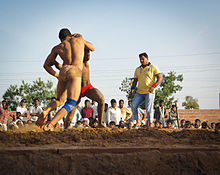
Wrestling match in Bharatpur, 2013.
Grappling arts (malla-vidya), adept either every bit sport or fighting fashion, are establish throughout the Indian subcontinent. Truthful combat-wrestling is chosen malla-yuddha, while the term malakhra refers to wrestling for sport. Malla-yuddha was codified into 4 forms which progressed from purely sportive contests of strength to actual full-contact fights known equally yuddha.[57] Due to the farthermost violence, this final grade is generally no longer practised. The second course, wherein the wrestlers attempt to lift each other off the ground for three seconds, persists in Karnataka. Traditional malla-yuddha is near extinct in the northward where it has been supplanted by kusti, but another grade chosen malakhra still exists in parts of India and Sindh, Islamic republic of pakistan[ commendation needed ]. Vajra-musti was another old grappling art in which the competitors wrestled while wearing a horned knuckleduster. In a afterwards manner called naki ka kusti (hook wrestling), the duellists fought with bagh nakha.[64] Numerous styles of folk wrestling are besides found in India'due south countryside, such as mukna from Manipur, Inbuan wrestling from Mizoram and Khomlainai among the Bodos.
Wrestling (Pehlwani) [edit]
Pehlwani is a form of wrestling from the Indian subcontinent. It was developed in the Mughal Empire past combining native malla-yuddha with influences from Persian varzesh-e bastani.[38] [39] Ane of the almost famous practitioners of pehlwani was The Great Gama (Ghulam Mohammad Baksh Barrel), who is considered one of the greatest wrestlers of all fourth dimension.[65]
Battle (Mushtiyuddha) [edit]
Battle (musti-yuddha) is traditionally considered the roughest class of Indian unarmed combat. In ancient times it was popular throughout northern Indian subcontinent, but is rarely skilful today. Boxers harden their fists by hitting stone and other hard objects. Matches may be either one-on-one or grouping fights. All kinds of strikes and grabs are allowed, and whatsoever part of the trunk may exist targeted except the groin.[57] Another course of boxing was loh-musti (meaning "fe fist"), said[ by whom? ] to accept been good by the God Krishna[ citation needed ]. In this variation, boxers fought while wielding a kara or steel bracelet like a knuckleduster[ citation needed ]. Grabs, kicks, biting and attacks to the groin were all legal, the only prohibition being spitting on the opponent which was considered rough and dishonourable[ commendation needed ]. The kara used for regular matches was unadorned[ citation needed ], only the form employed during state of war had i or more spikes effectually its edge[ commendation needed ]. The kara may be paired with one on each hand[ citation needed ], but it was generally simply worn on one mitt so the other hand could exist left free[ citation needed ]. In some cases the free manus could be paired with some other weapon, most unremarkably the bagh nakha[ citation needed ].
Kicking [edit]
Kick-fighting (aki kiti) is the preserve of tribes from Nagaland. While the entire Naga population of northeast Bharat and northwest Myanmar was traditionally known for their skill with broadswords (dao) and other weapons, disputes among tribesmen and between tribes were settled with a solely kick-based course of unarmed fighting. The goal is to either bulldoze the opponent to their knees or outside of the ring. Only the feet are used to strike, and fifty-fifty blocking must exist done with the legs.[66]
Pugilism [edit]
Many forms of unarmed gainsay (bāhu-yuddha or bhuja-yuddha) comprise besides wide an array of techniques to be accurately categorized. In modern times when the carrying of weapons is no longer legal, teachers of the martial arts often emphasise the unarmed techniques as these are seen to be more practical for cocky-defense purposes. A warrior who fights unarmed is referred to as a bhajanh, literally meaning someone who fights with their arms. The blank-handed components of Indian fighting arts are typically based on the movements of animals, Hindu deities. Binot, a Central Indian art which focuses on defending against both armed and unarmed opponents, maybe the earliest system of its kind. In the Mughal era, such fighters were known as ek-hath (lit. "one-hand"), and so named because they would demonstrate their art using only one arm.[57]
Bal Vidya [edit]
64 unlike types of skills and arts existed in ancient Bharat which lead to well-developed individuals boosting their mind, body, and intellect making them capable of performing their responsibilities efficiently and effectively on personal, social and national level. Today, unhealthy and irregular lifestyles, frustrations and rising competitions in every sphere of life are affecting the health of people, particularly the youth. In such a scenario, one of the ancient Indian arts referred to as "Bal Vidya" tin help non only to ameliorate the physical wellness only too upscale the mental and intellectual well-existence of a person. A strong heed and intellect is as important along with a strong body. Shree Aniruddha Upasana Foundation (Mumbai, India) attempts to review these aboriginal Indian martial arts grade and provides "Bal Vidya" training to both men and women costless of charge. Art forms like Mudgal Vidya, Vajra Mushthi, Surya Bhedan, Ashwa and various types of Yashwanti Malla Vidya using various weapons similar Laathi (atomic number 26-bound bamboo stick), Kaathi (Pole), Fari-Gadga, Dorkhand (rope)and Dandpatta (gauntlet-sword). A book detailing all these art forms with the title "Bhartiya Prachin Bal Vidya" (The Ancient Indian Bal Fine art) is also available for achieving proficiency through practice post attention training sessions.[67] [68] [69] [ circular reference ] [lxx]
Systems [edit]
Equally in other respects of Indian culture, Indian martial arts tin be roughly divided into northern and southern styles. The northern systems (including Pakistan and Bangladesh) may generically be referred to as shastra-vidiya, although this term is often used synonymously with gatka. The main difference is that the due north was more exposed to Persianate influence during the Mughal period, while the due south is more conservative in preserving ancient and medieval traditions. The exception to this rule are the northeastern states which, due to their geographic location, were closed off from most pre-European foreign invaders. Every bit a result, northeast Indian culture and fighting methods are also closely related to that of Southeast Asia. In addition to the major division between north and south, martial systems in the Indian subcontinent tend to be associated with certain states, cities, villages or ethnic groups.[71]
Regional styles [edit]
- Andhra Pradesh
Masters in Andhra Pradesh trace their lineage to the Vijayanagara empire, popular in Konaseema region. The native system of Chedi Talimkhana or yudhkaushalya che talim is often abbreviated to Talimkhana or simply Talim. The fine art makes use of several weapons which are used in preset forms. These include knife fighting (baku samu), sword fighting (katti samu), and staff fighting (kara samu) in addition to other weapons such as the gada (mace) and pata (guantlet sword).[web 4] [71]
- Bengal and Northeast India
Bengali war-dances bear attestation to the weapons one time used in the Bengal region. Today nigh of these weapons are used but in choreographed fights, including dao khela (knife fighting) and fala khela (sword fighting)[ citation needed ]. Traditional stick-fighting (lathi khela) is still used in free sparring today[ citation needed ]. The sticks may be short similar a cudgel or a long staff. The former are sometimes paired with a shield.[ citation needed ]
Lathi khela is a traditional Bengali martial art[72] [73] – a kind of stick fighting practised mainly in Bengal[72] [73] and Northeast Republic of india. Stick fighting has an ancient history in the Indian subcontinent. Rich farmers and other eminent people hired lathial for security and as a symbol of their power. Duels were used equally a way to protect or take land and other possessions. A proverb in some South Asian languages is "whoever wields the lathi keeps the cow". Zamindars (feudal lords) sent groups of lathial to forcefully collect taxes from villagers. Lathi training was at i fourth dimension included in the Bratachari system of education.[72] [73]
- Bihar
"Pari-khanda" is a fighting grade created by Rajputs and is still practised in many parts of Bihar. "Pari" ways shield and "khanda" ways sword according "Chhau" region, therefore this art uses sword and shield for fighting. This fighting form has given birth to a local dance form named "Chhau" dance and its martial elements have been fully absorbed by this dance. It is even practised in some parts of Jharkhand and Odisha. Chhau is the proper name of the traditional trip the light fantastic toe- drama of the eastern regions of India and is of 3 types. The three forms of "Chhau" are named later the commune or village where they are performed, i.east. the Purulia Chau of Bengal, the Seraikella Chau of Bihar and the Mayurbhanj Chau of Orissa.
- Karnataka
The Kannada fighting arts are taught exclusively at traditional training halls or garadi mane. Disciplines include unarmed combat (kai varase), staff-fighting (kolu varase) and sword-fighting (katti varase) amidst various other weapons. These are well-nigh oftentimes seen today simply during choreographed demonstrations at festivals.[71]
- Kashmir
Kashmiri swordsmanship is said to have an ancient history, only it was only much later that it acquired its modernistic name of sqay. Sqay survived a reject post-obit the partition of India past adopting competitive methodologies of karate and taekwondo. Types of competition include sparring, breaking, and forms or khawankay. Practitioners spar using fake swords chosen tora which are paired with a shield. Sparring is point-based, the points being awarded for successful hits with the tora or with the pes.[74]
- Kerala
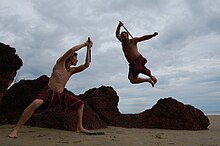
Kalaripayat stick-fighting
The Keralite martial of Kalaripayattu, came into its nowadays class through the kalari, the local variation of the gurukula educational establishment in Kerala. The most common weapons today are the staff, stick, sword, shield, spear, dagger and flexible sword, locally known as Urumi.[15] Kerala is also home to a native form of submission wrestling called Gatta gusthi.
- Maharashtra
The Marathas developed their fighting fashion based on the land's hilly geography. Mardani khel today teaches armed techniques for use in unmarried combat besides as defense confronting several opponents. Other weapons include the sword, shield, spear, dagger, kukri, double deer horns, and bow and arrow.[71]
- Manipur
The Manipuri fine art of Huyen langlon was once good past the country'due south indigenous loma tribes who would engage in duels governed by strict rules of comport. The armed component chosen thang-ta is named after the system's chief weapons, the thang (sword) and ta (spear). Practitioners spar through cheibi gatka in which a foam sword is used together with a shield. Unarmed huyen lalong is called sarit-sarak and is used in conjunction with thang-ta when the fighter loses their weapon.[nine]
- Nagaland
Aki Kiti is a semi-contact combat sport characterized by kicking and blocking solely using the soles of the anxiety. The discussion Aki Kiti means "kick fighting".
- Odisha
The Odishan martial art traces back to the paika class of warriors who were peculiarly known for their use of the khanda or double-edge straight sword. During times of peace, the paika would hone their skills through martial dances, forms-training and various acrobatics.[75] Their descendants have preserved these exercises in training halls called paika akhada, and demonstrate them mainly through street performances. Their method of sword preparation chosen phari-khanda is even so used equally the offset part of the chhau dance. Other weapons include the staff and guantlet-sword.[76]
- North W India
Martial arts in northwest India and side by side Pakistan were traditionally referred to by several terms but the most mutual today is shastar-vidiya or "science of edged weapons"[ commendation needed ]. Swordsmen practiced their techniques either in routines using real swords, or freestyle sparring with wooden sticks called gatka, a course of stick-fighting. Gatka is associated with the Sikh history and an integral office of an array of Rajput Shastar Vidiya. During the colonial flow, the term gatka was extended to mean northwestern martial arts in general[ citation needed ]. Some aspects of the fine art, such every bit the unarmed techniques or fighting in armour, are today skilful about exclusively past the Nihang lodge of Sikhs[ citation needed ]. Gatka incorporates several forms, each with their own set of weapons, strategies and footwork. In the late 18th century, this martial fine art farther developed as a recreational game and University Lahore codified its rules for playing it as a game.
- Tamil Nadu
 | |
| Also known as | Silambattam |
|---|---|
| Focus | Traditional Weapons |
| Country of origin | தமிழ்நாடு |
| Creator | God Murugan |
| Olympic sport | No |
| Martial art | Silambam |
The native Tamil martial art has come to be referred to as silambam later on its main weapon, the bamboo staff. Training begins with footwork patterns before progressing to stances and subsequently fighting techniques. Aside from its namesake, silambam includes a variety of weapons such as the sword, twin sticks, double deer horns, whip, sword, shield and sword, dagger, flexible sword and sickle. Unarmed silambam (kai silambam) is based on animal movements such as the snake, eagle, tiger and elephant. Other Martial Arts of Tamil Nadu are Varma Kalai, Adi Thadi, Malyutham,[77] Valariveechu, Vaalveechu, Gusthi (Boxing course of Tamil Nadu, not to be confused with Due north Indian Kushti which is a Wrestling art). In that location are 64 various kind of arts mentioned in Tamil sangam literature and they are unremarkably called equally aayakalaigal 64 but almost of them are now extinct and non in use nowadays.
Influence [edit]
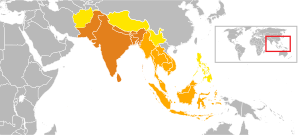
Historic Indosphere cultural influence zone of Greater India for transmission of elements of Indian culture including martial arts.
With expansion of Indosphere cultural influence of Greater India,[78] through transmission of Hinduism in Southeast Asia[79] [80] [81] and the Silk Road manual of Buddhism[82] [83] leading to Indianization of Southeast Asia through germination of non-Indian southeast Asian native Indianized kingdoms[84] which adopted sanskritized language[85] and other Indian elements[86] such as the honorific titles, Sanskritised naming of people, Sanskritised naming of places, Sankritised institutional mottos, Sanskritised educational institute names, as well as adoption of Indian martial arts, Indian compages, Indian music and dance, traditional Indian clothing, and Indian cuisine, a procedure which has also been aided by the ongoing historic expansion of Indian diaspora.[87] The martial arts influenced by the Indian martial arts include Angampora, Ankam, Bokator, Eskrima, Krabi krabong, Kbachkun Dambong-Veng, Khmer traditional wrestling, Pencak Silat, Silat, Thaing (Burmese), Võ thuật Bình Định, etc.
Encounter also [edit]
- Angampora
- Banshay
- Bataireacht
- Bōjutsu
- Gatka
- Jūkendō
- Kalaripayattu
- Kendo
- Kenjutsu
- Krabi–krabong
- Kuttu Varisai
- Mardani khel
- Shastar Vidya
- Silambam
- Varma kalai
- Tahtib
- Thang-ta
References [edit]
- ^ attested in Classical Sanskrit merely, specifically in the Anargharāghava.
- ^ attested from Epic Sanskrit; see Luijendijk, D.H. (2008). Kalarippayat: The Essence and Structure of an Indian Martial Art. Oprat (LuLu.com). ISBN978-1-58160-480-1. [ self-published source ]
- ^ a b c d "Actualizing Power and Crafting a Self in Kalarippayattu". Spa.ex.ac.uk. Retrieved 27 September 2015.
- ^ James G. Lochtefeld (2002). The Illustrated Encyclopedia of Hinduism: A-Thou . The Rosen Publishing Grouping. pp. 23–4. ISBN978-0-8239-3179-8.
- ^ Agrawal, Ashvini (1989). Rise and Fall of the Imperial Guptas. Motilal Banarsidass. ISBN9788120805927.
- ^ Kenoyer, Jonathan M. (1998). Ancient Cities of the Indus Valley Civilization. Oxford University Printing. ISBN9780195779400.
- ^ a b Phillip B. Zarrilli; Peter Hulton. Psychophysical Acting: An Intercultural Approach Later Stanislavski. Routledge. p. 66.
- ^ a b Denise Cush; Catherine A. Robinson; Michael York. Encyclopedia of Hinduism. Psychology press. p. 182.
- ^ a b George, Robinn (2010). "India's insistent intensity". Asian Geographic.
- ^ Section Thirteen: Samayapalana Parva, Book iv: Virata Parva, Mahabharata.
- ^ a b c d e f thou h i Kim Taylor. "Kronos: A Chronological History of the Martial Arts and Combative Sports". Ejmas.com. Retrieved 27 September 2015.
- ^ Jeanine Auboyer (1965). Daily Life in Ancient Bharat. France: Phoenix Press. pp. 58. ISBNi-84212-591-5.
- ^ a b Destruction of Maharashtra and the Marathas in the first half of seventh-century "Travels of Hsuen Tsang," Vol. 4, Samual Beal, P, 449.
- ^ a b The Timechart History of India. Robert Frederick Ltd. 2005. ISBN0-7554-5162-vii.
- ^ a b c d e Zarrilli, Phillip B. (1998). When the Body Becomes All Eyes: Paradigms, Discourses and Practices of Ability in Kalarippayattu, a South Indian Martial Fine art. Oxford: Oxford University Press.
- ^ Luijendijk 2008
- ^ [1] Archived 29 August 2009 at the Wayback Machine
- ^ Subramanian, Due north. (1966). Sangam polity. Bombay: Asian Publishing Firm.
- ^ Raj, J. David Manuel (1977). The Origin and the Historical Development of Silambam Fencing: An Ancient Self-Defence Sport of Republic of india. Oregon: College of Wellness, Physical Education and Recreation, Univ. of Oregon. pp. 44, fifty, & 83.
- ^ Sports Dominance of India (1987). Indigenous Games and Martial Arts of Bharat. New Delhi: Sports Authority of India. pp. 91 & 94.
- ^ a b John Keay (2000). India: A History. New Delhi: HarperCollins. ISBN0-00-255717-vii.
- ^ a b c Bruce A. Haines (1995). Karate'due south History and Traditions (p. 23-25). Tuttle Publishing. ISBN 0-8048-1947-5.
- ^ G. D. Singhal, 50. V. Guru (1973). Anatomical and Obstetrical Considerations in Ancient Indian Surgery Based on Sarira-Sthana of Susruta Samhita.
- ^ a b c Zarrilli, Phillip B. (1992). "To Heal and/or To Harm: The Vital Spots (Marmmam/Varmam) in Two South Indian Martial Traditions Part I: Focus on Kerala's Kalarippayattu". Journal of Asian Martial Arts. one (1).
- ^ Radhey Shyam Chaurasia (2002). History of Aboriginal India: Primeval Times to g A. D. Atlantic Publishers & Distributors. p. 207. ISBN81-269-0027-Ten.
- ^ Change, Joseph South. (August 1992b). The Wrestler's Trunk: Identity and Ideology in North India. Berkeley: University of California Press.
- ^ Historians such every bit P. B. Desai (History of Vijayanagar Empire, 1936), Henry Heras (The Aravidu Dynasty of Vijayanagara, 1927), B.A. Saletore (Social and Political Life in the Vijayanagara Empire, 1930), Chiliad.S. Gai (Archaeological Survey of India), William Coelho (The Hoysala Vamsa, 1955) and Kamath (Kamath 2001, pp157–160)
- ^ Suryanath U. Kamath (2001) [1980]. A concise history of Karnataka: from pre-historic times to the nowadays. Bangalore: Jupiter Books.
- ^ Nilakanta Sastri, K.A. (2002) [1955]. A history of Due south India from prehistoric times to the fall of Vijayanagar. New Delhi: Indian Branch, Oxford University Press. ISBN0-19-560686-8.
- ^ Henry Heras (1927). The Aravidu Dynasty of Vijayanagara. Madras.
- ^ Edward Grey (1892). Pietro Della Valle – The Travels.
- ^ Robert Sewell (1924). A Forgotten Empire (Vijayanagar): A Contribution to the History of Bharat.
- ^ For instance, the Akbarnama tells that Emperor Akbar practiced gatka every day
- ^ Wiethase, H. "Dhanurveda: The knowledge of the bow". bogenloewe . Retrieved 24 June 2014.
- ^ The Ain I Akbari of Abul Fazl 'Allami. Gorgias Press. 1993.
- ^ a b Tobias Capwell (2009). The World Encyclopedia Of Knives, Daggers And Bayonets. Anness Publishing.
- ^ "A history of Dasnami Naga Sanyasis, Sir Jadunath Sarkar, Sri Panchayati Akhara Mahanirvani, Allahabad" (PDF). Dspace.wbpublibnet.gov.in. Retrieved 27 September 2015.
- ^ a b Alter, Joseph South. (May 1992a). "The "sannyasi" and the Indian Wrestler: The Beefcake of a Relationship". American Ethnologist. xix (2): 317–336. doi:10.1525/ae.1992.xix.two.02a00070. ISSN 0094-0496.
- ^ a b Change, Joseph S. (1992b). The Wrestler'southward Body: Identity and Ideology in Northward India. Berkeley: Academy of California Press. ISBN0-520-07697-4.
- ^ Thou. L. Khurana (1993). Medieval India. Agra: Lakshmi Narain Agarwal. ISBN81-85778-15-9.
- ^ A History of Warfare: Field-Marshal Viscount Montgomery of Alamein, William Morrow & Co; 1st edition (January 1983), ISBN 978-0688016456
- ^ Edwards, Frank (2004). The Gaysh. ISBN9781874622963 . Retrieved ten March 2015.
- ^ "Odisha Regime Portal" (PDF). Orissa.gov.in. Retrieved 27 September 2015.
- ^ "Reminiscences of Paika Vidroha". Orissatoday.com. Retrieved 28 July 2010.
- ^ "Welcome to". Iakoweb.com. Archived from the original on 12 July 2011. Retrieved 28 July 2010.
- ^ "Paika Wildcat was the showtime liberty struggle: Orissa Governor, Odisha Current News, Odisha Latest Headlines". Archived from the original on nineteen July 2013. Retrieved 10 March 2015.
- ^ Luijendijk, D.H. (2005). Kalarippayat: India'south Aboriginal Martial Fine art. Boulder: Paladin Press. ISBN1-58160-480-7.
- ^ Runjeet Singh; Master of Lahore (June 1838). "The Saturday Magazine" (248).
- ^ "Martial Arts in India". Retrieved 10 March 2015.
- ^ "Welcome to IAKOWEB.COM". Archived from the original on 24 September 2015. Retrieved x March 2015.
- ^ (1.) bhrāntam (2.) udbhrāntam (iii.) āviddham (four.) āplutaṃ (5.) viplutaṃ (vi.) sṛtaṃ (seven.) sampātaṃ (viii.) samudīśañca (ix.-10.) śyenapātamathākulaṃ (251.one) (xi.) uddhūtam (12.) avadhūtañca (thirteen.) savyaṃ (14.) dakṣiṇam eva ca (xv.-16.) anālakṣita-visphoṭau (17.-18.) karālendramahāsakhau (251.2) (nineteen.-20.) vikarāla-nipātau ca (21.-22.) vibhīṣaṇa-bhayānakau (23–24.) samagrārdha (25.) tṛtīyāṃśapāda (26.-28.) pādardhavārijāḥ (251.3) (29.) pratyālīḍham (xxx.) athālīḍhaṃ (31.) varāhaṃ (32.) lulitan tathā (251.4ab)
- ^ Parmeshwaranand, Swami (2001). Encyclopaedic Dictionary of Puranas – Swami Parmeshwaranand. p. 467. ISBN9788176252263 . Retrieved 27 September 2015.
- ^ "Vasisthas Dhanurveda Samhita : (Text with English Translation)". Goa University Library . Retrieved eight May 2014.
- ^ Manmatha Nath Dutt (1869). Kamandakiya Nitisara or, The Elements of polity, in English. Cyberspace Archive. Calcutta, Manmatha Nath Dutt. Retrieved 24 June 2014.
- ^ P.C. Chakravarti (2004). The Art of State of war in Ancient India. Depression Cost Publications. ISBN978-8185557472.
- ^ Agni Purana. Sri Satguru Publications. 2009.
- ^ a b c d due east f Donn F. Draeger and Robert W. Smith (1969). Comprehensive Asian Fighting Arts. Kondansha International Limited.
- ^ "Traditional military practices in North Republic of india". 15 January 2014.
- ^ Desai, Sudha Vishwanath (1980). Social life in Maharashtra under the Peshwas. Popular Prakashan. p. 131. OCLC 8243834.
- ^ "History of Archery in India".
- ^ The Rig Veda/Mandala half dozen/Hymn 75/five
- ^ Gabriel, Richard A. (2002). The Great Armies of Artifact. Greenwood Publishing Group. ISBN978-0-275-97809-9.
- ^ no master attribution, quoted in Dirk H. A. Kolff. Naukar, Rajput, & Sepoy. The ethnohistory of the military machine labour market in Hindustan, 1450–1860. Academy of Cambridge Oriental Publications no. 43. Cambridge University Printing 1990.
- ^ Richard F. Burton (1884). The Book Of The Sword. Chatto and Windus. ISBN0-486-25434-8.
- ^ "The culture and crisis of kushti". The Hindu. 31 October 2013. Retrieved 2 July 2016.
- ^ "Nagaland Kickboxing". Last Human Standing. BBC and Discovery USA. 17 July 2007
- ^ "Bal Vidya and Yashwanti Mall Vidya".
- ^ "Bala Vidya (For Men and Women) – SHREE ANIRUDDHA UPASANA FOUNDATION". Archived from the original on 29 July 2017.
- ^ Kalā
- ^ "Threescore 4 arts of aboriginal india". 17 March 2015.
- ^ a b c d Christopher Fernandes (2011). Vajramushti: Martial Arts of India. Creative House International Press.
- ^ a b c Bipasha Raha; Subhayu Chattopadhyay (22 December 2017). Mapping the Path to Maturity: A Continued History of Bengal and the North-Eastward. Taylor & Francis. pp. 102–. ISBN978-ane-351-03412-8.
- ^ a b c S. Foster (10 June 2009). Worlding Dance. Palgrave Macmillan UK. pp. 129–. ISBN978-0-230-23684-4.
- ^ "International Council of Sqay". Archived from the original on five August 2018. Retrieved 5 November 2013.
- ^ "Paika Akheda the Martial Art of Odisha". International Journal of Concrete Education, Sports and Health . Retrieved 12 December 2020.
- ^ "Martial Traditions of Odisha". Odisha Review: 47–49. Retrieved 12 Dec 2020.
- ^ Marco Ferrarese (July 2014). "Keeping Silambam spinning". Penang Monthly: xx–22.
- ^ Kenneth R. Hal (1985). Maritime Merchandise and Country Development in Early Southeast Asia. University of Hawaii Printing. p. 63. ISBN978-0-8248-0843-3.
- ^ Guy, John (2014). Lost Kingdoms: Hindu-Buddhist Sculpture of Early Southeast Asia, Metropolitan museum, New York: exhibition catalogues. Metropolitan Museum of Art. ISBN9781588395245.
- ^ "The spread of Hinduism in Southeast Asia and the Pacific". Britannica.
- ^ Kapur; Kamlesh (2010). History Of Ancient India (portraits Of A Nation), ane/e. Sterling Publishers Pvt. Ltd. p. 465. ISBN978-81-207-4910-viii.
- ^ Fussman, Gérard (2008–2009). "History of India and Greater Republic of india". La Lettre du Collège de France (4): 24–25. doi:10.4000/lettre-cdf.756 . Retrieved 20 December 2016.
- ^ Coedès, George (1968). Walter F. Vella (ed.). The Indianized States of Southeast Asia. trans.Susan Brown Cowing. Academy of Hawaii Press. ISBN978-0-8248-0368-1.
- ^ Manguin, Pierre-Yves (2002), "From Funan to Sriwijaya: Cultural continuities and discontinuities in the Early Historical maritime states of Southeast Asia", 25 tahun kerjasama Pusat Penelitian Arkeologi dan Ecole française d'Extrême-Orient, Jakarta: Pusat Penelitian Arkeologi / EFEO, pp. 59–82
- ^ Lavy, Paul (2003), "As in Sky, Then on Globe: The Politics of Visnu Siva and Harihara Images in Preangkorian Khmer Civilisation", Journal of Southeast Asian Studies, 34 (i): 21–39, doi:10.1017/S002246340300002X, S2CID 154819912, retrieved 23 Dec 2015
- ^ Kulke, Hermann (2004). A history of Republic of india. Rothermund, Dietmar 1933- (fourth ed.). New York: Routledge. ISBN0203391268. OCLC 57054139.
- ^ Kulke, Hermann (2004). A history of Bharat. Rothermund, Dietmar, 1933– (4th ed.). New York: Routledge. ISBN0203391268. OCLC 57054139.
- ^ "Nagas: In one case were warriors". The Times of India. Archived from the original on 3 December 2013. Retrieved 10 March 2015.
- ^ "National Museum, New Delhi". Retrieved 10 March 2015.
- ^ "National Museum, New Delhi". Retrieved 10 March 2015.
- ^ B.V.Southward. Bhaskar (15 Oct 2010). "Aboriginal martial art form still in faddy". The Hindu . Retrieved 10 March 2015.
dulaneythereoper1965.blogspot.com
Source: https://en.wikipedia.org/wiki/Indian_martial_arts
0 Response to "Martial Arts Why Dont People Show Up for Trial"
Post a Comment